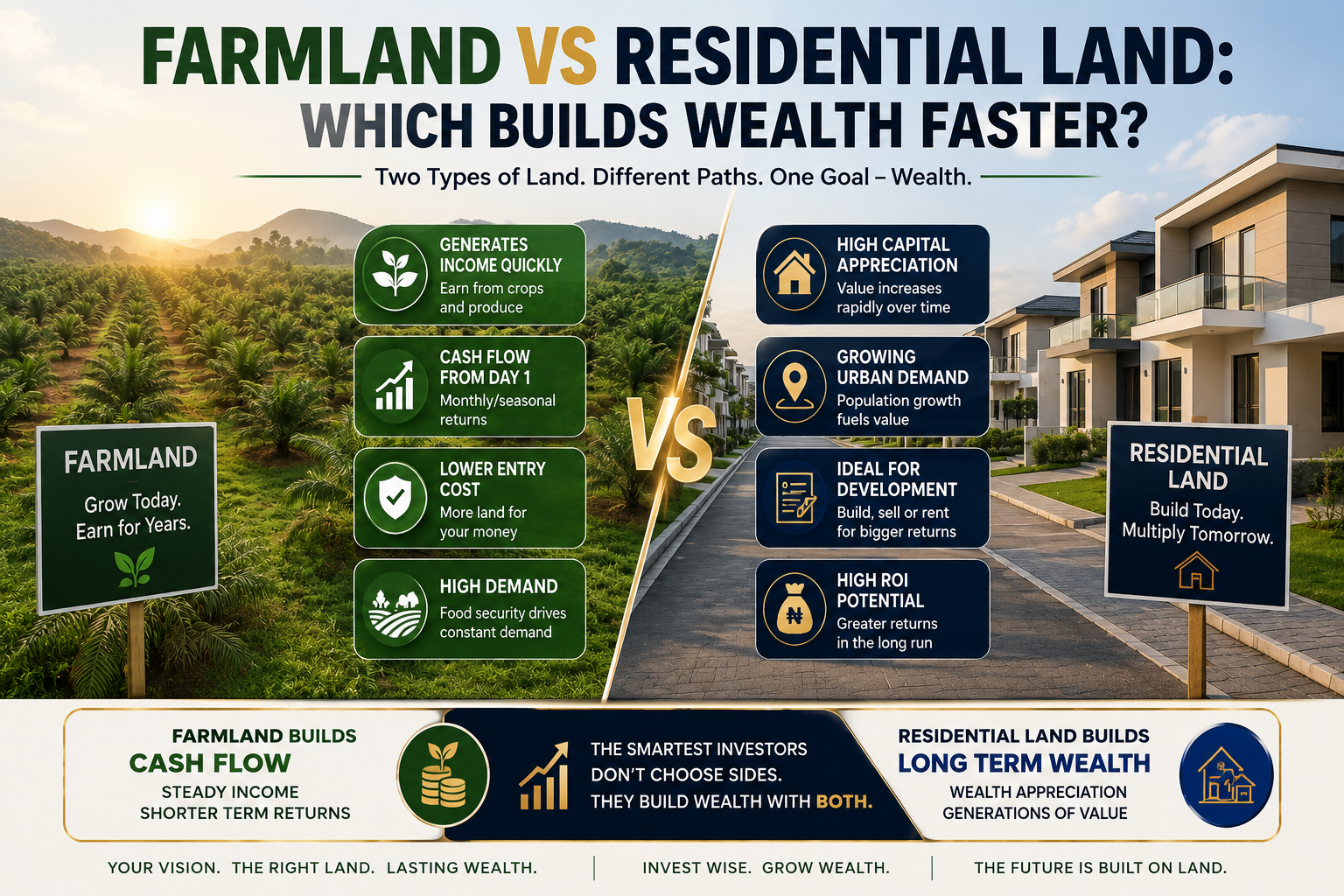
Farmland vs Residential Land: Which builds wealth faster ?
Land is one of the few assets in Nigeria that almost every investor agrees on this principle. The disagreement starts when you get specific: farmland or residential land? One promises steady, low-drama appreciation. The other promises faster capital gains in the right location, with more moving parts to manage. Here’s what the actual numbers say.
The Case for Residential Land: Speed
Residential land in Nigeria’s fastest-growing corridors is appreciating at a pace few other assets can match. In the Epe and Ibeju-Lekki axis — driven by the Lekki Deep Sea Port, the Dangote Refinery, and the ongoing Lagos-Calabar Coastal Highway — raw land that sold for under ₦3 million a plot a few years ago is now compounding at an estimated 20–30% a year. Current acre pricing in the same corridor ranges from roughly ₦12 million to ₦45 million in Epe, and ₦30 million to over ₦100 million in Ibeju-Lekki for titled land close to the port.
That speed comes with a trade-off: entry cost. Residential land in high-growth zones is priced for growth already happening, and it demands larger capital outlay upfront. It’s also more sensitive to short-term economic swings — infrastructure delays, policy changes, or a slowdown in the broader property market can stall appreciation in a way that’s harder to predict than farmland’s slower, steadier curve.
The Case for Farmland: Consistency
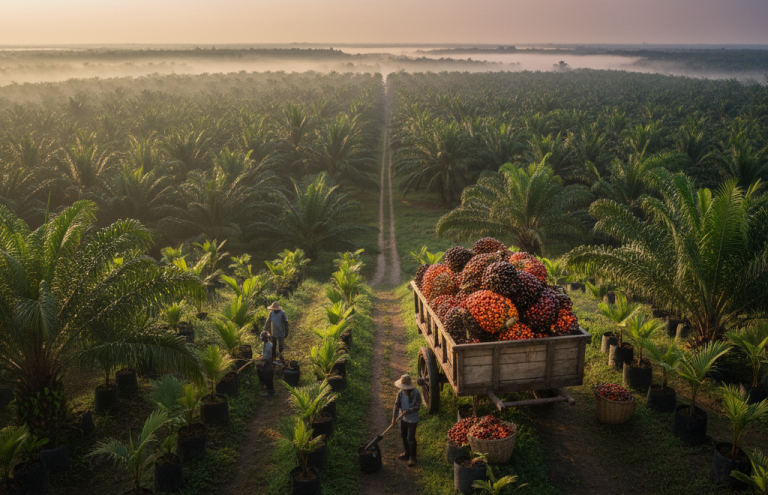
Farmland tells a different story. In Ogun State’s agricultural zones — places like Kobape, Sagamu and Imeko — an acre of farmland currently costs as little as ₦800,000 to ₦2.5 million, a fraction of residential pricing even in nearby industrial corridors. That low entry cost is farmland’s biggest structural advantage: it lets an investor control significantly more acreage for the same capital.
The return profile is different too. Long-running data from the National Council of Real Estate Investment Fiduciaries puts U.S. farmland’s average annual return at around 11.5% since 1991 — a figure that has outperformed both equities and bonds over the same stretch, largely because farmland values have historically held up during downturns that hit stocks hard, including 2008 and the COVID-19 period. Nigerian farmland has followed a similar low-volatility pattern: values track food demand and population growth rather than speculative sentiment, and land itself rarely depreciates.
Farmland also offers something residential land generally doesn’t at the entry level: an income stream while you wait. Investors can lease acreage to farmers, put it into production themselves, or simply hold it — collecting cash flow rather than paying carrying costs with nothing coming back until a sale.
The Real Wealth-Builder: Farmland That Becomes Residential Land
The strongest argument for farmland isn’t farmland versus residential land — it’s farmland that becomes residential land. Much of what’s now some of Lagos’s most valuable real estate was farmland a generation ago. Investors who bought early, when it was still priced as agricultural land, captured both stages of appreciation: the slow farmland climb, then the sharp re-rating once development reached it.
That’s the core logic behind land banking as a strategy in Nigeria right now: buying farmland in the path of “outward infrastructure expansion” — the corridors just ahead of where roads, ports, and refineries are pushing city boundaries — and holding it through the transition from agricultural to residential zoning.
Which One Actually Builds Wealth Faster?
It depends on what “faster” means to you.
If you’re optimizing for speed and have the capital, residential land in an active growth corridor — bought early, with clean title — will outrun farmland on a pure appreciation basis. 20–30% annual compounding in Epe or Ibeju-Lekki beats almost any farmland return on paper.
If you’re optimizing for capital efficiency, income, and downside protection, farmland wins. Lower entry cost means more acreage per naira, a possible income stream while you hold, and a return profile that’s historically held up better in downturns.
If you’re optimizing for the biggest total return over the longest horizon, the answer is neither in isolation — it’s farmland positioned to become residential land. Buy agricultural land ahead of infrastructure, hold through the rezoning, and you capture both return profiles in a single asset.
The fastest wealth isn’t necessarily built by picking a side. It’s built by knowing which corridors are still priced like farmland today but won’t be in five years.