Palm Oil Investment in Nigeria: Real Numbers, Real Returns.
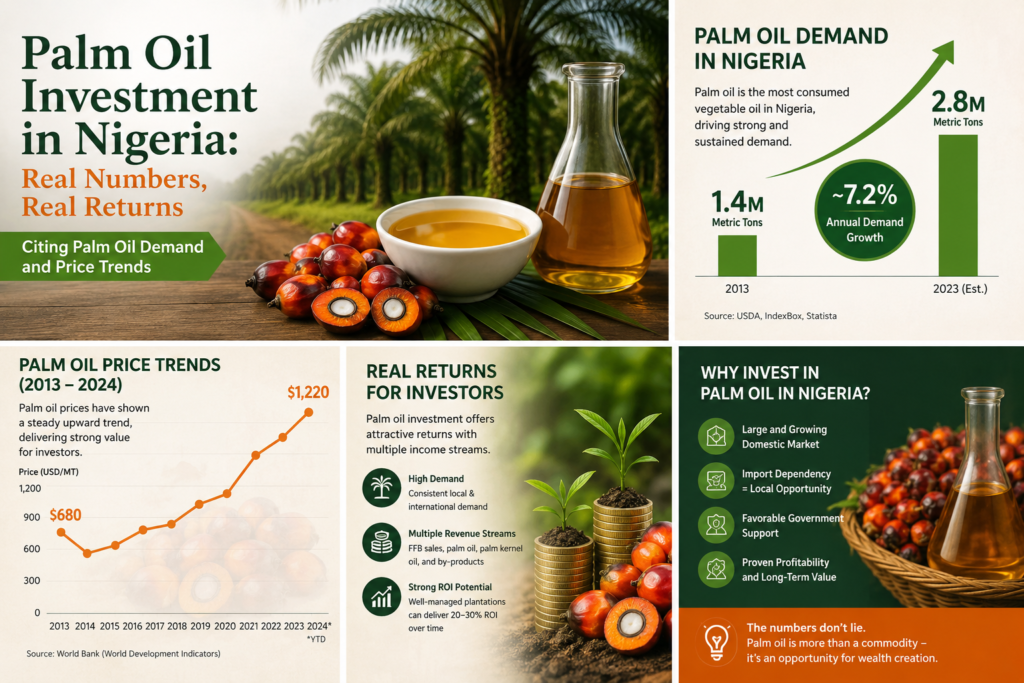
Nigeria was once the world’s leading palm oil producer. By the 1960s, the country supplied more than 40% of global output. Today it’s a net importer, spending hundreds of millions of dollars a year to plug a gap between what Nigerians consume and what local plantations can grow. That gap is precisely why palm oil has quietly become one of the most talked-about agricultural investment stories in the country.
This post lays out the actual numbers — demand, supply, prices, and returns — behind that story.
The Demand-Supply Gap Is the Whole Story
Nigeria’s palm oil production currently sits around 1.4–1.5 million metric tonnes a year. Domestic demand, by contrast, is estimated at 2.2–2.5 million metric tonnes, depending on the source. That leaves an annual shortfall of roughly 1 million tonnes, which the country closes through imports from Malaysia and Indonesia.
That import dependency isn’t cheap. Nigeria’s annual crude palm oil import bill runs between $500 million and $600 million, according to figures shared by the Ministry of Agriculture and Food Security. In naira terms, industry estimates put the figure north of ₦300 billion a year — money leaving the country to buy a crop Nigeria’s climate is naturally suited to grow.
Structurally, the gap isn’t closing on its own. Nigeria’s palm oil consumption has been growing at roughly 0.7% a year, while local production has struggled to keep pace due to ageing plantations, slow adoption of high-yield seedlings, and weak logistics linking producing states in the south to consuming markets further north. Industry researchers point to those transport and infrastructure bottlenecks as a direct driver of the price gap between growing regions and the rest of the country.
Prices: Firm, and Structurally Supported
Global crude palm oil prices have been on a firm-to-upward trend through 2026, supported by tight supply from major producers and steady buying from the food and biofuel sectors. Regional benchmarks in Northeast Asia, Southeast Asia, and North America have all held in a broadly similar range through the middle of the year, with analysts pointing to biodiesel mandates, oleochemical demand, and steady food consumption across Asia and Africa as a long-term floor under prices — even in periods when supply looks relatively abundant.
Within Nigeria specifically, local CPO prices have been trending upward for a more basic reason: the deficit itself. When domestic supply can’t meet demand, and imports carry currency and logistics costs on top of global prices, local prices get pulled up with them. The naira devaluation of 2023–2024 only reinforced that floor, making imported palm oil more expensive relative to what it costs to grow domestically.
What the Returns Actually Look Like
The clearest evidence that this isn’t just a policy talking point sits in the financials of Nigeria’s listed plantation companies. Presco Plc and Okomu Oil Palm Plc — the country’s two largest oil palm producers — posted a combined ₦72.86 billion in pre-tax profit in the first quarter of 2026 alone. For full-year 2025, Presco reported ₦178.6 billion in profit before tax, up 57.3% year-on-year, while Okomu posted ₦87.3 billion, up 63.6%.
Rather than paying that windfall out, both companies have been reinvesting heavily into plantations, mills, and processing capacity. Presco held nearly ₦125 billion in biological assets (standing plantations) at the end of March 2026, alongside ₦59 billion in inventory and ₦136.5 billion in cash. Okomu’s biological assets stood at ₦85.4 billion. That’s a signal worth paying attention to: the companies closest to the ground on production costs and demand are choosing to expand rather than cash out.
At the smallholder and mid-scale level, the underlying unit economics explain why. A hectare of mature oil palm can produce 10–18 tonnes of Fresh Fruit Bunches a year, and that harvest converts into several separate revenue streams — crude palm oil, palm kernel oil, palm kernel cake for animal feed, and biomass by-products. Once established, a plantation keeps producing for 25+ years with comparatively low ongoing costs relative to annual crops. Government-backed estate programmes presented to stakeholders this year projected internal rates of return of 18–25%, with payback periods of five to seven years.
Policy Tailwinds
The Federal Government has made palm oil a visible part of its agricultural agenda under the Renewed Hope programme, with a stated ambition to reach full self-sufficiency by 2050 and lift Nigeria’s share of the global palm oil market to 10%, alongside a target of creating up to 2 million jobs in the sector within six years. States are moving in parallel — Akwa Ibom, one of Nigeria’s core producing regions, has earmarked roughly ₦31 billion for seedlings, plantation expansion, and a coordinated marketing push for local growers in 2026. Import tariffs on palm oil also continue to give domestic producers a price cushion against swings in the global market.
The Bottom Line
Nigeria’s palm oil story isn’t a speculative pitch — it’s a supply-demand mismatch backed by real, published financials. Demand is outpacing supply by roughly a million tonnes a year, that gap is costing the country half a billion dollars annually in imports, global and local prices are both structurally supported, and the country’s largest producers are reinvesting profits rather than distributing them, because they expect the shortfall to persist. For investors weighing exposure to Nigerian agriculture, those are the numbers that matter — not projections, but what’s already showing up on the balance sheet.